Journal / Product / The Bottleneck is moving
Let AI help decide what to build next
Building has become fast. Deciding what to build has not. With coding agents, a team can ship more in a week than it used to in a month, which makes a wrong choice more expensive, not less. The bottleneck moves to prioritisation.
The Impact/Effort model
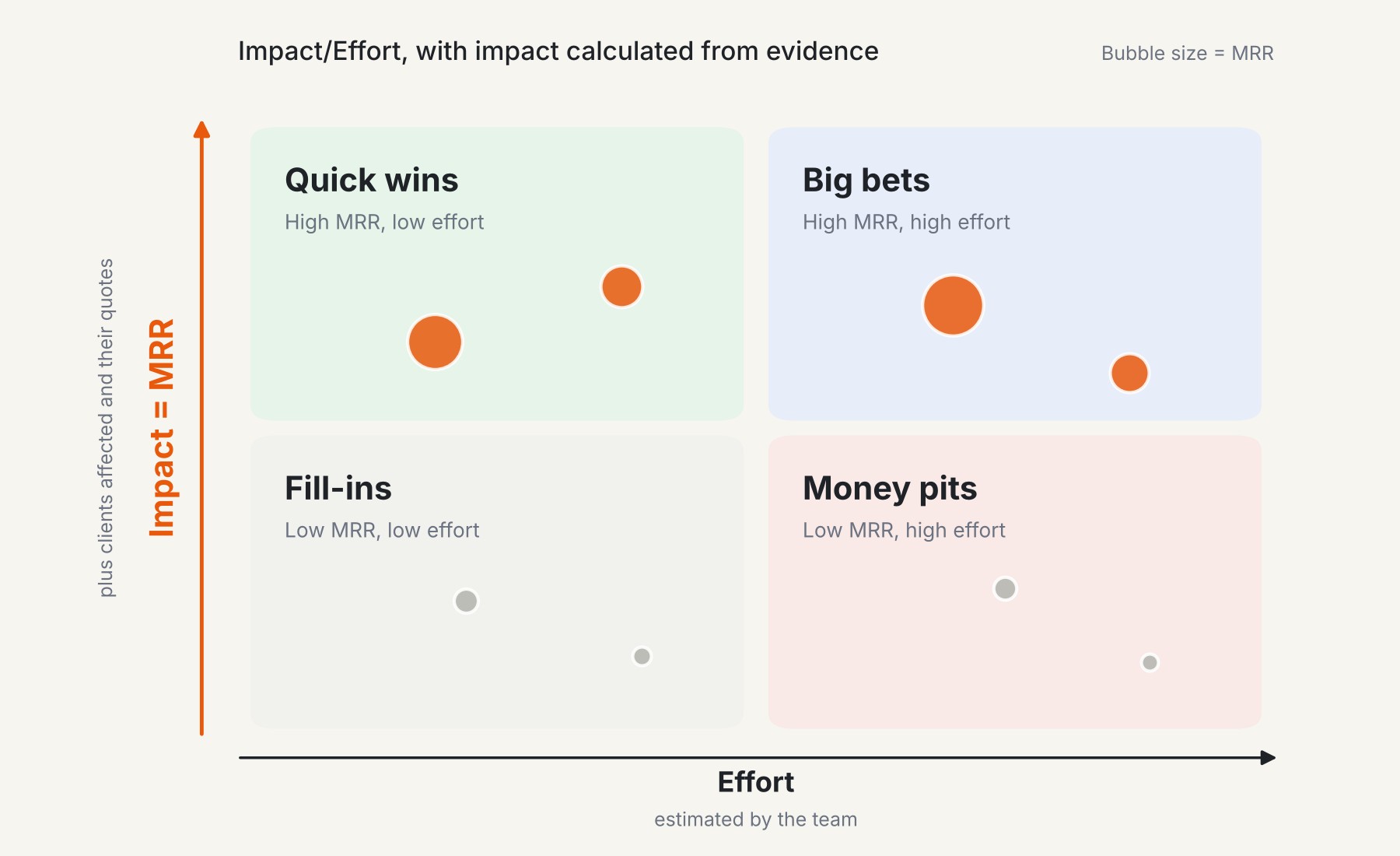
The idea is simple. Score every opportunity on two axes, how much value it creates and how much work it takes, and place it in one of four boxes:
- Quick wins: high impact, low effort. Do these first.
- Big bets: high impact, high effort. Plan these carefully.
- Fill-ins: low impact, low effort. Do them when there is time.
- Money pits: low impact, high effort. Say no.
It is easy to explain to anyone in the company, which is why it survives next to more detailed frameworks such as RICE.
Why impact scores are usually guesses
Effort is the easier axis. Engineers can estimate it, and they get better at it over time.
Impact is where it goes wrong. In most prioritisation sessions, impact is a number someone puts on a sticky note. It depends on who is in the room, which customer called last and who argues best. The evidence exists, but it is spread across sales calls, support tickets, CRM notes, Slack threads and usage data. Nobody has the time to read all of it before every decision.
That is exactly the kind of work AI is good at.
Calculating impact from evidence
At Swat.io we created a Claude skill that calculates the impact of an opportunity from the evidence instead of from opinion. It looks at three things:
- MRR: how much recurring revenue sits with the customers who are affected or asking for it.
- Clients: how many customers it affects, and which ones.
- Client quotes: what customers actually said about it, gathered from all our sources.
The skill brings these together into an impact score, with the evidence behind it. That last part matters. A score on its own invites the same debate as before. A score with the revenue, the customers and their own words next to it changes the conversation from "I think" to "this is what customers told us".
From score to product brief
The skill does not stop at the score. It turns the result into a simple product brief:
- the problem, in the customers' words
- who is affected and how much revenue is involved
- user stories that describe what customers need to do
- specs that describe what the solution has to cover
The brief is short on purpose. It is a starting point for the team, not a finished document. Because the brief and the user stories are structured, they also work as input for a coding agent or a prototype, which shortens the path from decision to something customers can see.
Tools that already do this
You do not have to build this yourself. Several companies already package parts of it:
- Zefi clusters internal and external feedback, helps product managers prioritise it, generates initiatives and keeps each opportunity linked to the feedback behind it, with two-way sync to Jira, Linear and other ticketing tools.
- BuildBetter turns calls, tickets and other customer signals into themes and projects, and passes that context on to coding agents such as Claude Code, Codex and Cursor.
These tools are a fast way to start, especially if you do not want to maintain your own setup. We chose a Claude skill because it lets us define impact exactly the way we want, with MRR at the centre, and because Claude already has access to all our sources.
Who decides
The skill does not set the priorities. People do.
AI makes the impact side of the model honest and fast to fill in. The team still estimates the effort, still weighs the opportunity against the strategy and still decides what goes on the roadmap. Some things will always score low on revenue and still be the right call: fixing a security issue, entering a new market, building the foundation for something bigger. The model informs the decision; it does not make it.
What changes is the quality of the discussion. Instead of spending the meeting arguing about whether something matters, the team spends it on the trade-offs that actually need judgement.
How to set this up in your company
- Agree what impact means. Decide which signals count, such as revenue, number of customers and customer feedback, and how you weigh them.
- Connect the sources. Give Claude access to the places where customer evidence lives: CRM, support, call recordings and Slack.
- Write the impact skill. Describe how to find the evidence for an opportunity, how to calculate the score and how to show the evidence behind it.
- Add the brief template. Define what a product brief contains, including user stories and specs, so every brief looks the same.
- Keep effort with the team. Let engineers estimate effort, or review the first estimate Claude gives them.
- Review the matrix together. Use the scores and briefs as input for your prioritisation meeting, not as its outcome.
- Check the scores against reality. After launch, compare the expected impact with what happened, and adjust how you calculate it.
This article is part of the series The Bottleneck is moving. If you are using AI to prioritise in your team, I would like to hear how you calculate impact.