Journal / Strategy
What innovation in large organisations actually looks like
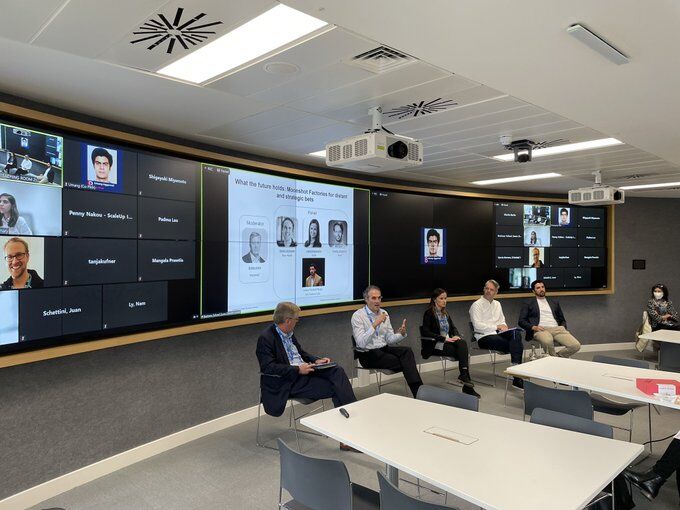
I recently joined a panel at Imperial College Business School alongside speakers and representatives from GSK, Telefónica, Bosch, Airbus, Bayer, frog, TechFounders, and academics including Chuck Eesley and Steve Blank. The conversation was about innovation inside large organisations — how it happens, why it so often doesn't, and what it actually takes to make it stick.
Innovation is not a department
The most consistent thread across every company represented in the room was this: the organisations that do innovation well don't treat it as a separate function. There is no innovation team that sits apart from the business and hands ideas downstream. The work is embedded — in product, in engineering, in commercial teams — and the role of any dedicated innovation function is to create the conditions for it, not to own it.
When innovation lives in a silo, it produces decks. When it lives in the business, it produces products.
The structure is the strategy
Large organisations move slowly not because people lack ambition, but because the structure makes speed expensive. Approval chains, budget cycles, risk frameworks, legal review — each one is rational in isolation. Together, they create a system that is optimised for not failing rather than for learning fast.
The companies that break through this tend to share one thing: they have found a way to ring-fence a small team with real authority and a tolerance for failure that the rest of the organisation does not have. Not a skunkworks hidden from leadership — but a unit that has explicit permission to operate differently, with protection from the gravitational pull of the core business.
The question is not whether to have that structure. It is whether leadership is willing to defend it when the first failure arrives.
Most innovation dies in the handover
An idea can survive discovery, survive prototyping, survive a successful pilot — and still die when it is handed to the core business to scale. The incentives change. The ownership is unclear. The team that built it moves on. The core business has its own targets and its own quarterly pressure, and absorbing a new, unproven product line is a cost before it is a return.
This is where most corporate innovation programmes quietly end. Not with a failed experiment, but with a successful one that nobody scaled.
The handover is not an afterthought. It needs to be designed in from the start — who owns it after the pilot, what the resourcing looks like, and what success criteria the receiving team is actually held to.
The people who make it happen are translators
In every organisation with a functioning innovation practice, there are a small number of people who can move between the experimental world and the operational world without losing credibility in either. They speak the language of the business unit and the language of the startup. They can translate a messy, uncertain early-stage idea into something a CFO will fund, and translate a strategic directive into something an engineer will build.
These people are rare. Developing them, retaining them, and giving them the authority to act is one of the highest-leverage things an organisation can do.
What this means in practice
None of this is theory. Every company at that panel had examples of initiatives that worked and ones that didn't, and the pattern was consistent. The failures were not failures of idea quality. They were failures of structure, incentive, and handover.
The honest version of corporate innovation is unglamorous. It is fighting for budget in a planning cycle that does not fit your timeline. It is running a pilot that succeeds and then spending eighteen months convincing a business unit to adopt it. It is doing the political work alongside the creative work, because without it, the creative work goes nowhere.
That is what innovation in large organisations actually looks like. And it is still worth doing.
Thanks to Dr. Cristobal Garcia-Herrera, Markus Perkmann, and Isha Gupta for organising the event, and to all the speakers and panellists for a genuinely honest conversation.